Beat Shooter Night: Rap Battle
- 4.2
- Rating
- 1.00M
- Installs
- Free
- Price
 Analysis by App-foxy
I approached Beat Shooter Night: Rap Battle as a music game first, but its real test is how comfortably different people can read the action, control it, and keep playing in everyday situations. Developed by HOLA GAME, it combines a rap-battle theme with beat-based shooting, so the appeal comes from matching visual action to music rather than simply listening along. I found it easy to understand at a basic level, although the fast visual rhythm can make the experience demanding for players who need more time to process movement or coordinate taps.
The game is free to start and is rated for Everyone, which makes it approachable for families and casual players. It has reached over a million installs and holds a 4.3 average from around two thousand ratings, signs that the central idea has connected with a fairly broad audience. Still, popularity does not automatically make a game comfortable for every player. My experience was more useful when I looked beyond the bright presentation and asked a practical question: can someone with different visual, motor, attention, or environmental needs actually enjoy it without unnecessary friction?
How Beat Shooter Night: Rap Battle Feels to Use
I focus here on the game’s central appeal: turning a rap-themed music challenge into quick, visual action. In my experience, that simple premise makes it easy to understand, but it also means the screen—not just the soundtrack—demands your attention. The next section looks at what that feels like during an ordinary play session.
You May Also Like

 Blood Strike: 2.5 Anniversary
Blood Strike’s Loadouts Turn Every Drop Into a Tactical Gamble
A close look at Blood Strike’s custom loadouts: how fast access to signature weapons reshapes its battle royale rhythm, rewards preparation, and narrows the gap between fights.

 Pandora - Music & Podcasts
Pandora’s Music Is Easy to Start, but Harder to Recover
Pandora’s strength is its low-effort path from a seed to a station. Its weak spot is how much confidence it asks you to place in connection, setup, and quiet recovery.

 8 Ball Pool
 Is Built on Rivalries, Rematches, and Routine
A close look at the rivalries, rematches, shared routines, and unanswered safety questions that turn a quick pool match into a persistent mobile community.

 Samsung Music
’s Quiet Strength Is Playing What You Already Own
Its reach comes less from spectacle than from dependable access to a personal library. That simplicity is both the app’s strongest retention engine and its ceiling.

 AccuWeather: Weather Radar
AccuWeather Review: A Quick, Clear Forecast for Everyday Decisions
For everyday plans, the best forecast is the one you can understand quickly. AccuWeather makes rain timing, radar, and local conditions easy to act on, with a few trade-offs.

 Hill Climb Racing
Why Hill Climb Racing Still Turns Crashes Into One More Run
A tiny car, a bumpy hill and one more upgrade: Hill Climb Racing keeps resurfacing because its simple chaos makes every near-miss feel personal.
More From Our News Desk



Readable action and straightforward navigation
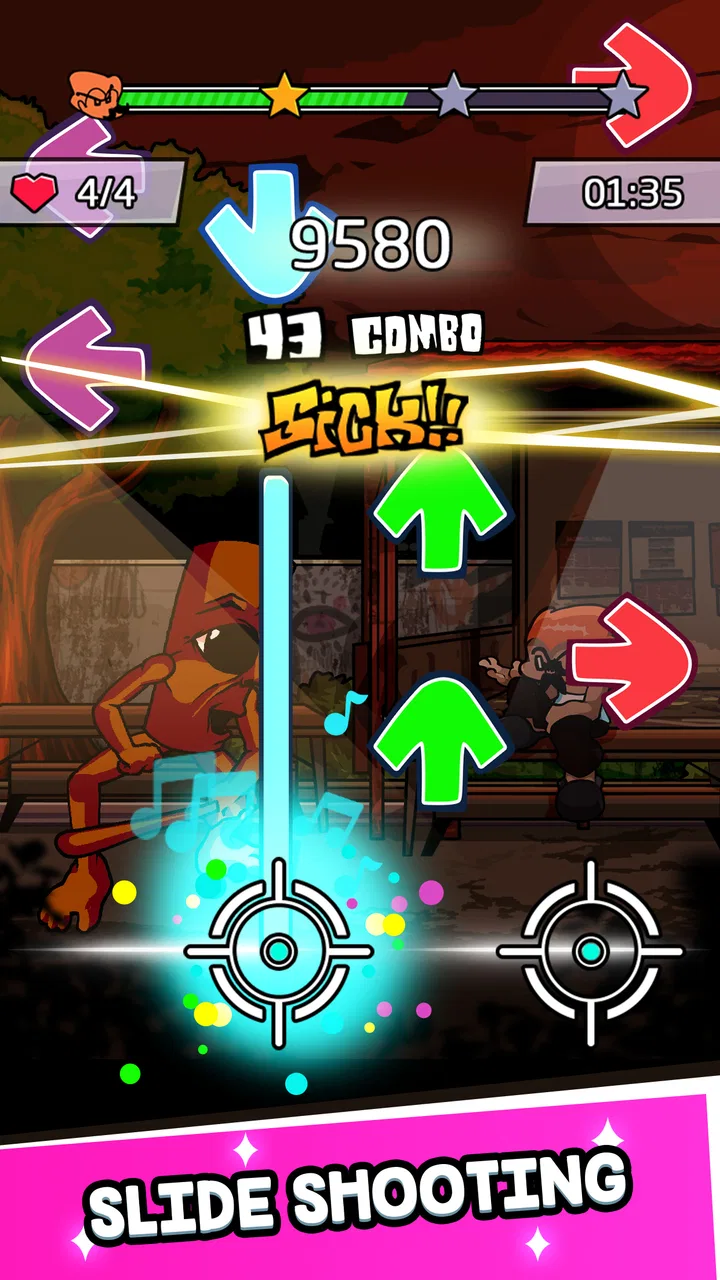
The strongest accessibility point is the simplicity of the basic concept. You are not learning a complicated role-playing interface or managing a large inventory. The game presents itself as a beat shooter, and that gives the player an immediate mental model: watch the action, aim, and respond in time with the music. For someone new to rhythm games, this is less intimidating than a title filled with layered menus, character statistics, and long tutorials.
That clarity matters in short sessions. I can imagine opening it while waiting for an appointment, handing it to a younger player, or using it as a quick change of pace after a long day. The rap-battle framing gives the experience a recognizable identity, but the controls remain centered on the timing challenge rather than requiring the player to understand a complicated story.
Navigation is most comfortable when the player can focus on one task at a time. The visual presentation is designed to keep attention on the beat and targets, which helps reduce the mental overhead found in many larger music games. At the same time, a screen full of movement can become busy. Players who are sensitive to visual clutter, flashing effects, or rapidly changing targets may need to decide quickly whether the presentation feels energizing or tiring.
One useful habit is to spend the first session learning the visual language instead of chasing a high score. I recommend watching how targets appear, where the important action sits, and how the game signals a successful response. This makes the second session more manageable because the player is no longer trying to decode the screen and react at the same time. For children, that gradual approach can also prevent the game from feeling like a test they immediately failed.
The short store description calls it “Beat Shooter,” and that is a fair summary of the interaction, but it does not explain the practical difference between playing with full attention and playing casually. This is not background music with occasional taps. The player has to remain visually engaged. If you want a game that can run while you are doing something else, this is not the right fit.
Motor demands, timing, and sensory comfort
The main physical demand is quick, accurate touch input. A player needs to aim or tap at the right moment, and the music encourages a steady rhythm. That can feel natural for people who already enjoy rhythm games, but it may be frustrating for anyone with slower hand movement, limited precision, tremor, or difficulty coordinating what they see with what they do.
I would not describe the controls as conceptually difficult. The challenge comes from timing and repetition. That distinction is important. Someone may understand exactly what the game wants but still struggle to perform the action quickly enough. In that situation, the game can remain enjoyable as a relaxed music toy, but it may not be satisfying if success depends on consistently accurate reactions.
Players with one-handed use in mind should test the layout during a calm section rather than assuming it will be comfortable. A compact touch interaction can be convenient, especially on a phone, but repeated tapping may become tiring if the hand has to stay in one position. I would use a light grip, keep the device supported when possible, and take breaks between songs or attempts. Those are simple adjustments, but they make a noticeable difference during longer sessions.
Sound is equally important. The music is not merely decoration; it helps establish the timing. Playing with audio muted or very low may remove one of the clearest cues, leaving the player dependent on visual movement. That creates a trade-off for people who cannot hear the music, are playing in a quiet shared space, or find strong audio uncomfortable. In those situations, the game may still be usable if the visual timing is clear enough, but the experience is likely to feel less complete than it does with sound.
I also recommend checking the phone’s own sound controls before starting. A player who needs a quieter experience can lower the device volume, use headphones if that is comfortable, or choose a private setting. Headphones can make the beat easier to follow, but they are not automatically better for everyone; some players need to remain aware of people, traffic, or other sounds around them. The best choice depends on the environment rather than on the game alone.
Playing in different places and situations
This game makes the most sense in a stable setting where the phone can be held securely and the player can look at the screen without interruption. On a sofa, at a desk, or during a quiet break, the beat-based format is easy to pick up. The free entry point also lowers the risk of trying it for a few minutes before deciding whether the style suits you.
It is less suitable when the player is walking, riding a bicycle, crossing a street, or responsible for watching a child. The need to track targets and respond to rhythm makes divided attention a real problem. Even a short session should happen somewhere safe and stationary. That is not a criticism unique to this title, but the fast visual response makes it especially important here.
A realistic everyday use case would be a ten-minute break between tasks. I would sit down, play one or two attempts, and stop before the repeated timing starts to feel tiring. This works better than treating the game as something to play continuously for an entire evening. The rap and music theme provides a quick burst of energy, while the simple premise means I do not need to remember a complicated plot after putting the phone away.
For families, the Everyone rating makes the game easier to consider for a mixed-age household, but an age label should not be confused with universal comfort. A younger player may enjoy the colorful action while still needing help with the timing. Another player may find the pace overwhelming even though the content is broadly suitable. I would let the person playing decide whether the speed and sound feel comfortable, rather than assuming the rating answers that question.
The game can also work for someone who wants a music-themed alternative to a standard arcade shooter. The focus is not on realistic combat or a long competitive campaign; it is on reacting to rhythm and visual targets. If you usually choose music games because they feel more playful and less intense than action games, this may be appealing. If you prefer slow, deliberate puzzle solving, the beat-driven pressure may feel like the wrong kind of challenge.
Where the inclusive experience still has limits
The largest barrier is the lack of room for different reaction speeds. A player who needs extra processing time may understand the pattern but lose because the response window moves on before they are ready. That can make the game feel inaccessible in practice even when the rules are easy to explain. I would judge it by comfort rather than by whether the player can technically launch and operate it.
Visual intensity may create another barrier. Fast movement, contrast between targets and background, and music-driven action can be exciting, but they can also contribute to fatigue or discomfort for some players. I would start with a short session and stop if the screen becomes tiring. Players who are prone to motion discomfort should be especially cautious about extended play and should avoid forcing themselves to continue just to improve a score.
Touch accuracy is a further concern. A phone screen gives limited physical feedback, so a player cannot feel a target before tapping it. That is normal for this type of game, but it disadvantages anyone who relies on tactile guidance. A stable device position can help, and using a larger screen may make targets easier to see, though the experience will still depend on the game’s touch response and the player’s coordination.
In-app purchases range from $0.99 to $2.99 per item. The free starting point is helpful, but I would still recommend that families review purchase controls on the device before handing over the phone. This is less about the size of an individual purchase and more about making sure a quick, exciting game does not lead to an accidental transaction. Players who want a completely purchase-free experience should keep that possibility in mind before settling into the game.
The current version is 1.3.1 and it requires Android 7.0 or later. That makes device compatibility a practical first check, particularly for anyone using an older phone. A game can be well suited to a player’s abilities and still be unavailable on the device they depend on. I would confirm the operating system before planning to use it on a spare or family phone.
Small strategies that make play more comfortable
My first recommendation is to separate learning from performance. During the opening attempts, focus on identifying where the targets appear and how the beat relates to the action. Do not treat every missed response as a failure. This approach is especially useful for players who need more time to build a visual routine, because it reduces the pressure to react perfectly from the beginning.
My second tip is to use the environment as part of the setup. Sit down, support the phone, reduce glare, and choose a volume that leaves the beat audible without becoming tiring. Glare can make moving targets harder to distinguish, while an unstable grip can turn a manageable tap into an accidental miss. These changes do not alter the game, but they remove distractions that can be mistaken for a lack of skill.
Third, treat fatigue as information. If the screen feels difficult to follow after several attempts, taking a break is more useful than repeatedly pushing through. Rhythm games reward repetition, but repetition only helps when the player can still see, hear, and respond comfortably. Short sessions are also a good way to discover whether the game suits someone with attention limitations or a low tolerance for sensory intensity.
For players with hearing differences, I would experiment with relying more heavily on the visual beat and keeping the phone at a comfortable volume rather than assuming headphones are necessary. For players with visual difficulties, a larger display and good lighting may help, but the fast pace can remain a fundamental obstacle. The important distinction is between improving the setup and expecting the setup to remove the game’s central timing demand.
Compared with a traditional music player, this is far more interactive but far less flexible. A player cannot simply relax and let songs run in the background. Compared with a large rhythm-game series, it feels more immediately focused on shooting and rap presentation, with less appeal for someone seeking deep progression, extensive customization, or a broad instrument-style challenge. Its advantage is quick understanding; its cost is that the same focused design leaves fewer ways to adapt the experience to different abilities.
Who should try it and who should choose something else
I would recommend it to players who like music games, enjoy short arcade sessions, and are comfortable with fast touch reactions. It is also a reasonable choice for someone who wants a free way to sample a rap-themed rhythm experience without committing to a lengthy game. The Everyone rating and straightforward premise make it approachable for casual households, provided an adult keeps an eye on device purchases and the player’s comfort.
I would be more cautious about recommending it to someone who needs adjustable timing, reduced visual motion, strong accessibility controls, or a slower pace. If a player’s enjoyment depends on reading large, calm interfaces or using deliberate inputs, a turn-based music puzzle or a more configurable rhythm game would probably be better. The same applies to anyone looking for a game that can be played with minimal attention while listening to music; this title asks for active visual participation.
It is also not my first choice for extended sessions. The central loop is easy to understand, but repeated aiming and tapping can become tiring, especially when the player is trying to improve accuracy. I see it as a focused burst of play rather than a complete substitute for every kind of music game. That limitation is not necessarily a flaw, but it should shape expectations before downloading.
HOLA GAME has built the experience around an immediately recognizable combination: rap atmosphere, rhythm, and shooting-style touch action. That combination gives the game personality, while the uncomplicated premise helps new players get started. The challenge is that the same speed and sensory emphasis can exclude people who need more time, quieter presentation, or alternative controls.
My inclusive verdict is therefore positive but selective. Beat Shooter Night: Rap Battle is easiest to recommend when the player can comfortably follow fast visual cues, make repeated touch responses, and play in a safe, settled environment. It is free, broadly age-rated, and simple enough to understand quickly, but it should not be presented as an effortless fit for every player. Try it in a short session, adjust the phone and sound to suit the person playing, and pay attention to fatigue rather than chasing a score.
For me, the game succeeds as a compact music arcade experience with a clear rap identity. Its best quality is immediacy: I can understand the goal quickly and get into the rhythm without studying a long rulebook. Its most important weakness is equally clear: there is little protection for players who struggle with speed, visual intensity, or precise touch input. If those demands match your abilities and your preferred style, it is worth trying. If they do not, a slower or more adjustable alternative will offer a kinder experience.
FAQs for Beat Shooter Night: Rap Battle
01What is Beat Shooter Night: Rap Battle about?
Beat Shooter Night: Rap Battle is a rhythm-based game that combines elements of music and shooting. Players navigate through various levels, tapping to the beat of popular rap tracks while aiming to hit targets. The game offers an engaging mix of music and action, challenging players to maintain rhythm and accuracy.
02Is Beat Shooter Night: Rap Battle free to download?
The game is free to download on both Android and iOS platforms. However, it does offer in-app purchases that allow players to unlock additional content, such as new levels, tracks, and customization options. While the core game is accessible without spending money, these purchases can enhance the overall experience.
03What are the system requirements for the game?
Beat Shooter Night: Rap Battle requires Android 5.0 or higher and iOS 11.0 or later. It is optimized for both phones and tablets, ensuring a smooth gaming experience. Players should ensure they have enough storage space available for additional track downloads and updates to enjoy uninterrupted gameplay.
04Can I play Beat Shooter Night: Rap Battle offline?
Yes, Beat Shooter Night: Rap Battle can be played offline, allowing you to enjoy the rhythm-action gameplay without an internet connection. However, certain features, such as downloading new tracks or accessing leaderboards, will require an internet connection. It’s recommended to connect periodically for updates and new content.
05How does the game handle updates and new content?
The developers regularly update Beat Shooter Night: Rap Battle with new tracks, levels, and features to keep the gameplay fresh and exciting. Players can expect seasonal events and challenges that offer exclusive rewards. Keeping the app updated ensures access to the latest content and improvements.
Pros
- Engaging rhythm-based gameplay.
- Wide variety of music tracks.
- Intuitive controls for all ages.
- Visually appealing graphics.
- Regular updates with new content.
Cons
- In-app purchases can be pricey.
- Requires internet for full features.
- Ads can interrupt gameplay.
- Limited character customization.
- High battery consumption.

Beat Shooter Night: Rap Battle
Gallery